
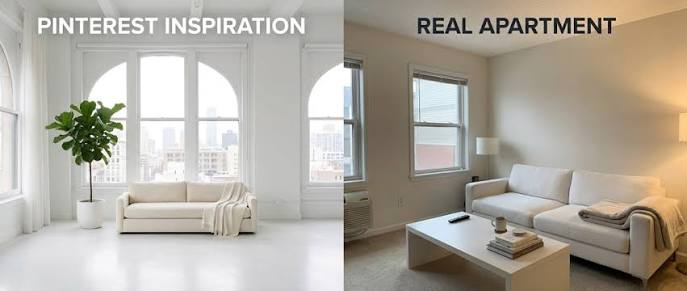
If you’ve ever spent hours pinning dreamy living rooms, styled bedrooms, and perfectly arranged furniture vignettes, only to bring similar pieces into your own home and feel underwhelmed by the result, you’re far from alone. The gap between Pinterest-perfect interiors and real, lived-in homes is one of the most common frustrations in home design — and it’s rarely about taste or effort. It’s about understanding what’s actually happening behind the photo.
This guide breaks down why Pinterest (and Instagram) design often looks so different from reality, and how to apply what actually works from those images to your own space.
Why Pinterest Photos Look So Different From Real Rooms
Professional Photography Does Heavy Lifting
Most viral interior photos are shot by professional photographers using wide-angle lenses, controlled lighting setups, and careful post-processing. Wide-angle lenses in particular make rooms appear significantly larger and more spacious than they are in person, which is why a “small cozy living room” on Pinterest might look roomy, while your similarly sized space with the same furniture feels cramped.
Natural or supplemental lighting is also carefully arranged in professional shoots — often multiple lights positioned to eliminate shadows and even out tones — something that’s difficult to replicate with a single overhead fixture or a lamp in the corner.
Styling Is Temporary
Many photographed rooms are styled specifically for the shoot and don’t reflect how the space is used day to day. Cords are hidden, remote controls disappear, personal clutter is removed, and furniture is arranged for visual balance rather than practical use. A coffee table styled with three carefully placed objects photographs beautifully, but in daily life, that same table usually has mail, a laptop, and a coffee mug on it.
Scale Is Often Distorted
Camera angle and lens choice can make furniture look larger, smaller, or spaced differently than it actually is. A sofa that appears to leave generous walking space in a photo might, in person, sit much closer to the walls or other furniture than the image suggests.
Trends Are Curated, Not Universal
Pinterest boards tend to aggregate the most visually striking examples of a trend, which are often show homes, high-end renovations, or professionally designed spaces with significantly larger budgets than the average home renovation or furniture refresh.
The Psychological Side of the Gap
Part of the disappointment people feel isn’t just about design accuracy — it’s about expectation versus reality more broadly. Research on social media and comparison suggests that curated images, whether personal photos or aspirational design boards, can create a distorted baseline for what “normal” looks like. It’s worth remembering that Pinterest boards are collections of best-case scenarios, not documentation of everyday living. A photographed room is a moment, not a lifestyle.
Recognizing this can help take some of the pressure off — your home doesn’t need to look like a stationary showroom to be well-designed. It needs to function well and feel good to live in.
How to Bridge the Gap: Practical Tips
1. Focus on the Elements, Not the Whole Image
Rather than trying to recreate an entire Pinterest room exactly, identify the specific elements that appeal to you — a color palette, a furniture silhouette, a material combination — and adapt those individual elements to your own space and lighting conditions. A room rarely translates one-to-one, but a design principle usually does.
2. Account for Your Actual Lighting
Before committing to a color scheme or furniture finish based on a photo, consider your room’s actual lighting. North-facing rooms tend to receive cooler, more diffused light, while south-facing rooms get warmer, more direct light throughout the day. A deep navy sofa that looks rich and moody in a bright, naturally lit photo might read as flat or dark in a room with limited natural light. When possible, test paint swatches or fabric samples in your own space at different times of day before finalizing a purchase.
3. Measure Everything
Because photos distort scale, always work from real measurements rather than visual impressions from an image. If you love a furniture arrangement from a photo, look up the actual dimensions of similar pieces and map them onto your room’s floor plan before buying, rather than assuming the proportions shown in the photo will translate directly.
4. Style for Real Life, Not Just the “Reveal”
Instead of styling a space purely for a photogenic moment, think about how it needs to function daily. Choose furniture with practical storage for the items that would otherwise clutter a coffee table or console. A console table with drawers, for example, allows you to tuck away remotes and mail while still keeping a clean surface most of the time.
5. Layer in Personal, Functional Items Gradually
Many Pinterest images feel aspirational precisely because they lack the personal, functional clutter of daily life — but a home entirely without those items can feel sterile and impersonal to actually live in. Rather than removing all personality to chase a magazine-perfect look, focus on choosing furniture and storage that lets your real, lived-in items look intentional rather than chaotic.
6. Don’t Underestimate Furniture Quality Differences
High-end showroom or designer furniture often has a different finish, weight, and construction quality than budget alternatives that may look similar in a photo. A velvet sofa photographed under professional lighting can look dramatically different from a similarly colored but lower-quality fabric under regular home lighting. When possible, view fabric swatches and finish samples in person, or order samples online, before committing to a big-ticket furniture purchase based on a photo alone.
7. Recreate Layouts With Painter’s Tape First
Before rearranging furniture to match an inspiration photo, use painter’s tape on the floor to map out the proposed layout at full scale. This simple step often reveals whether a photographed arrangement will actually work in your space — or whether walkways will be too narrow, or furniture will block natural light or doorways.
When to Let Go of the Exact Image
Sometimes, despite best efforts, a specific Pinterest room simply won’t translate to your space due to differences in room shape, ceiling height, natural light, or budget — and that’s completely normal. Interior designers frequently note that the best real-world spaces are the ones tailored to the specific room and the people living in it, not exact replicas of someone else’s photographed home.
If a particular image continues to feel unattainable, it can help to ask: what is it about this photo that I actually want to feel in my own space? Often, the answer isn’t a specific sofa or exact color, but a broader feeling — calm, organized, warm, spacious — that can be achieved through several different furniture and design choices suited to your actual room.
Final Thoughts
The gap between Pinterest boards and real homes isn’t a sign that you’re doing design “wrong” — it’s a natural result of professional photography, curated styling, and distorted scale that most inspiration images rely on. By focusing on the underlying design principles rather than trying to replicate a photo exactly, measuring carefully, and styling for how you actually live, you can bring the spirit of your favorite inspiration images into a home that’s not just photogenic, but genuinely comfortable and functional to live in every day.
Ready to bring your Pinterest inspiration to life? Explore our furniture collection to find pieces that translate beautifully from photo to real life — built for how you actually live.
