
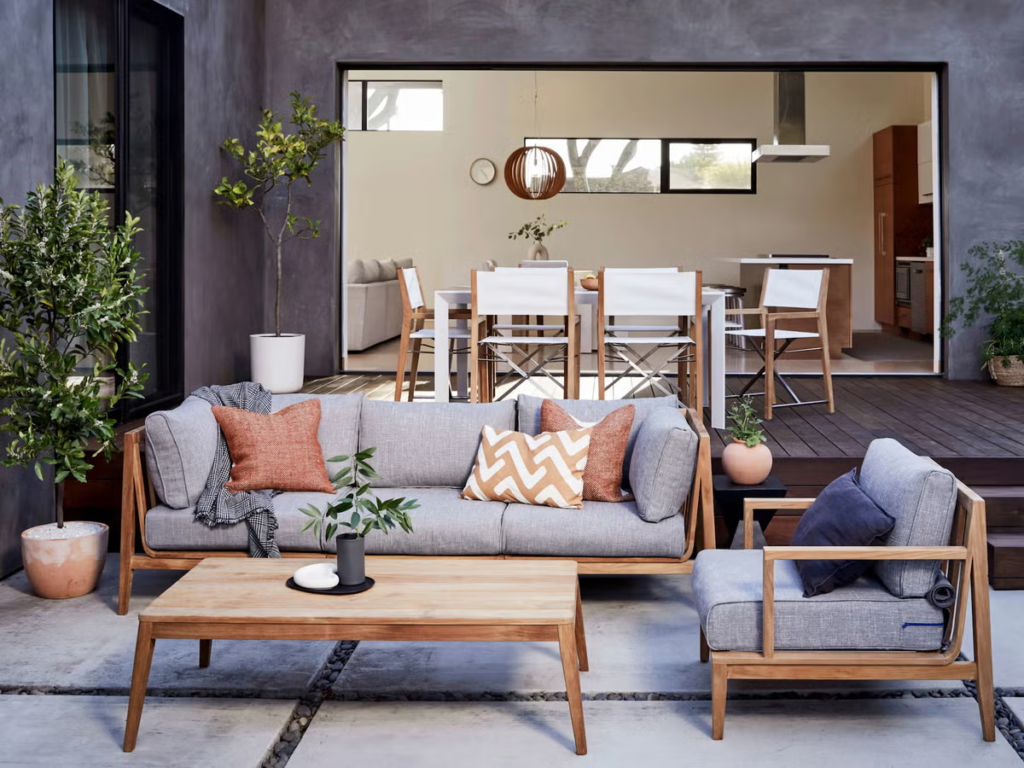
Outdoor furniture shopping tends to follow an even narrower script than indoor furniture. Walk through most garden centers or big-box patio sections and you’ll find the same handful of options: a resin wicker sectional, a glass-top table with matching stackable chairs, and a string of solar lanterns. It’s functional, weatherproof, and almost entirely interchangeable from one backyard to the next.
Building an outdoor space with real character takes the same principles that work indoors — quality materials, mixed sourcing, and intentional statement pieces — adapted for sun, rain, and temperature swings. Here’s how to do it without sacrificing durability.
Why Outdoor Furniture Defaults to Basic
Outdoor furniture faces a harder set of constraints than indoor pieces. It has to survive UV exposure, moisture, temperature swings, and in many climates, freezing winters. Manufacturers respond to those constraints by leaning heavily on a small set of proven materials — resin wicker, powder-coated aluminum, and tempered glass — because they’re reliably weatherproof and cheap to produce at scale.
The result is an outdoor furniture market that optimizes for durability and low cost far more aggressively than the indoor furniture market does, which is part of why it can feel even more uniform.
The good news is that durability and distinctiveness aren’t actually in conflict — it just requires knowing which materials and sources offer both.
Materials That Hold Up and Stand Out
Teak is one of the best options for outdoor furniture that’s both durable and distinctive. Its natural oils make it highly weather- and rot-resistant without chemical treatment, and it develops a beautiful silver-gray patina over time if left untreated — a look that reads as intentional and elevated rather than worn out.
Powder-coated steel or iron, especially in sculptural or vintage-inspired frames, offers a heavier, more substantial presence than the ubiquitous thin aluminum frames found in most patio sets.
Natural or synthetic rattan and wicker, when woven in more architectural or asymmetrical patterns rather than the standard basket-weave, can look dramatically more distinctive while offering the same weather resistance as basic versions.
Concrete and stone, increasingly used for outdoor side tables and planters, bring a sculptural, grounded quality that’s nearly impossible to achieve with typical outdoor materials — and require almost no maintenance.
Outdoor-rated performance fabrics have improved enormously in recent years, now available in far more sophisticated colors and patterns than the nautical stripes and solid neutrals that once defined the category.
Statement Pieces for Outdoor Spaces
Just as with indoor rooms, one well-chosen anchor piece can transform an outdoor space more than an entirely matched set ever could.
- A single oversized, sculptural lounge chair instead of a full matching seating set
- A hammock chair or woven swing seat as an alternative to traditional patio seating
- A vintage or vintage-style daybed for lounging, rather than a standard chaise
- An architectural fire pit or fire table that doubles as a gathering point and a sculptural centerpiece
Placing one distinctive piece in an otherwise simple, neutral outdoor layout creates the same visual hierarchy that works indoors — the statement piece draws attention, while everything else provides quiet support.
Mixing New and Vintage Outdoors
Vintage outdoor furniture is a genuinely underused resource. Mid-century patio furniture, in particular, was often built with wrought iron or heavier-gauge materials than much of what’s sold today, and it tends to have more distinctive silhouettes than current mass-market options.
When buying vintage for outdoor use:
- Inspect metal frames closely for rust that’s structural rather than cosmetic — surface rust can often be sanded and repainted, but deep corrosion compromises strength
- Plan on replacing cushions and fabric regardless of the frame’s condition, since outdoor textiles rarely survive decades of sun and moisture
- Consider having a powder coater refinish an older metal frame, which can restore both appearance and weather resistance affordably
Don’t Overlook Planters and Greenery as Furniture
In outdoor spaces, plantings function almost like furniture in how much they shape the feel of a space. Oversized, sculptural planters — in materials like fiber-cement, concrete, or glazed ceramic — can anchor a seating area the same way a bold coffee table does indoors.
Mixing planter heights, shapes, and materials rather than using a matched set of identical pots adds the same kind of visual interest that mismatched dining chairs bring to an indoor table.
Lighting Sets the Mood After Dark
String lights have become the default outdoor lighting solution, and while they’re pleasant, an outdoor space relying solely on them can feel unfinished after sundown.
Consider layering in:
- Low, sculptural path or landscape lighting along walkways or garden beds
- A statement outdoor floor lamp or lantern near a seating area, rated for outdoor use
- Tabletop lanterns or candle holders in varied heights on side tables
Layered lighting outdoors mirrors the same principle used indoors: multiple light sources at different heights create depth, rather than relying on one flat, overhead source.
Weatherproofing Without Sacrificing Style
A common concern with more distinctive outdoor furniture is durability — will a beautiful vintage-inspired piece actually survive the elements the way a basic resin set does? In most cases, yes, with reasonable care:
- Use furniture covers during off-season months or extended periods of heavy weather
- Bring cushions and fabric pieces indoors or into storage when not in active use
- Apply teak oil or sealant annually if you prefer to maintain teak’s original color rather than let it silver naturally
- Store lightweight pieces indoors during severe storms rather than assuming outdoor-rated means storm-proof
Distinctive outdoor furniture generally requires the same maintenance as basic outdoor furniture — the difference is in the design, not the upkeep.
Building an Outdoor Space With Real Character
The instinct to default to a matched patio set outdoors is understandable — weather resistance narrows the options, and matched sets are marketed as the easy, foolproof choice. But the same principles that create a distinctive indoor room apply outside: choose quality materials that age well, let one or two pieces carry the visual weight, and mix sourcing rather than buying everything from a single collection.
An outdoor space furnished with intention doesn’t just look better in photos — it becomes a place people actually want to spend time, rather than a functional but forgettable extension of the house.
