
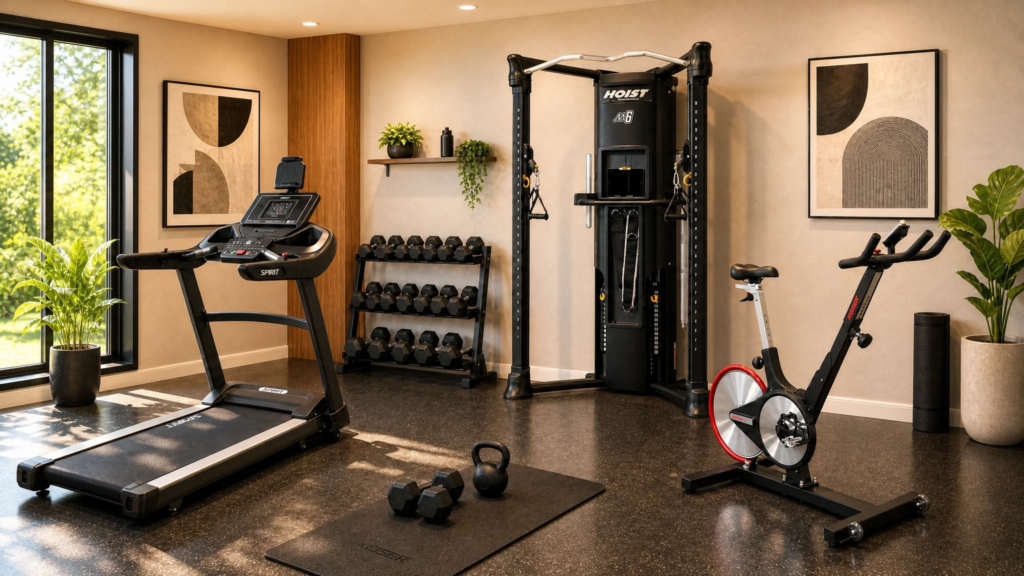
1. Dedicated Flooring as the Foundation
Standard carpet or hardwood is no longer considered acceptable for a serious home gym in 2026. Rubber flooring tiles, rolled rubber, cork, and foam-topped platforms have become the baseline expectation rather than a premium upgrade. The reasoning is entirely functional: proper flooring provides cushioning for joints during impact workouts, grip for weightlifting, and sound deadening that matters enormously in apartments and homes with shared walls. Dedicated flooring is increasingly treated as the true foundation of a home gym, on par with choosing the right equipment.
2. Fewer, Higher-Quality Pieces
Equipment editing is a major trend for 2026, with designers and fitness coaches consistently recommending fewer, better pieces over a room stuffed with single-purpose equipment. A single high-quality cable machine, a rack of adjustable dumbbells, and a foldable pull-up bar can outperform a room cluttered with cardio machines that end up collecting dust. This curated approach doesn’t just look better — it also makes the space function more efficiently, since every piece of equipment earns its footprint.
3. Foldable and Space-Saving Equipment
As home gyms increasingly occupy small corners, balconies, or shared living spaces rather than dedicated rooms, foldable and collapsible equipment is a defining trend for 2026. Foldable benches, movable racks, and wall-mounted storage help optimize every inch of available space, allowing a compact area to convert quickly between workout mode and everyday use. This approach makes a real home gym achievable even in homes without a spare room to dedicate entirely to fitness.
4. Adjustable, Multi-Function Dumbbells
Technology-driven adjustable dumbbells are among the biggest equipment trends of 2026. These smart dumbbells sync with apps to track repetitions, adjust resistance on the fly, and guide users through virtual workouts, offering real-time feedback without the bulk of a full multi-station machine. Their compact, all-in-one design pairs naturally with the broader shift toward minimal-footprint home gym equipment.
5. Wall-Mounted and Under-Furniture Storage
Storage innovation is reshaping how home gym equipment is kept when not in use. Modular systems that tuck under a bed, or wall-mounted units that double as decorative mirrors when idle, are becoming increasingly common in 2026. Many of these newer strength devices use electromagnetic resistance rather than heavy iron plates, which allows for a genuinely full-body strength workout in a fraction of the space traditional equipment would require.
6. Dual-Purpose Room Furniture
One of 2026’s most practical home gym trends is the dual-purpose room — a space that functions as a workout area during morning and evening exercise windows and converts smoothly into a home office, studio, or guest room the rest of the day. Furniture chosen for these spaces needs to serve both functions well, favoring pieces that can be quickly reconfigured, folded away, or repurposed rather than equipment that permanently claims the room.
7. Recovery and Wellness Zones
Fitness in 2026 is about more than lifting and cardio; recovery has become a genuine design priority. Dedicated recovery corners furnished with yoga mats, foam rollers, and massage tools are showing up in home gyms as a defining trend for the year, reflecting a broader shift toward mixing physical fitness with mental wellness. This recovery-focused furniture is increasingly treated as essential rather than optional, sitting alongside strength and cardio equipment rather than being an afterthought.
8. Full-Height Mirrors as a Design Essential
Full-height, wall-mounted mirrors remain essential home gym furniture in 2026, valued for supporting proper form, technique, and posture during workouts. Beyond their functional role, mirrors also help reflect light and make a home gym feel more open and spacious, which matters especially in smaller or converted spaces where visual expansion can make a real difference in how usable the room feels.
9. Biophilic and Nature-Inspired Elements
The biophilic design trends reshaping living rooms and kitchens are making their way into home gyms in 2026. Plants, natural light, and nature-adjacent color palettes are increasingly part of workout space design, chosen for their ability to improve air quality and reduce psychological stress. Natural light in particular is associated with longer, more enjoyable workout sessions, making a well-placed window or skylight a genuine design priority rather than an incidental feature.
10. Sustainable and Eco-Friendly Materials
Sustainability is playing a growing role in home gym furniture and equipment choices in 2026, with recycled rubber mats and ethically made dumbbells gaining traction among fitness-focused homeowners. This mirrors the sustainability push happening across furniture trends in every other room of the house, reflecting a broader consumer expectation that even fitness equipment should be responsibly sourced.
What’s Falling Out of Style in Home Gyms This Year
A few once-common home gym approaches are losing ground in 2026:
- Rooms crammed with single-purpose cardio machines — replaced by a curated, editing-focused approach favoring fewer, higher-quality pieces.
- Standard carpet or hardwood as workout flooring — increasingly considered inadequate compared to dedicated rubber, cork, or foam flooring.
- Improvised, unplanned workout corners — giving way to intentionally designed spaces with dedicated flooring and thoughtfully chosen furniture.
- Fitness-only equipment with no recovery component — replaced by setups that build in dedicated space for stretching, foam rolling, and recovery.
Frequently Asked Questions About 2026 Home Gym Furniture Trends
What is the biggest home gym furniture trend for 2026? Dedicated, purpose-built flooring is widely considered the foundation of 2026 home gym design, with rubber, cork, or foam surfaces now viewed as essential rather than optional.
Do I need a lot of equipment for a home gym in 2026? No. The 2026 trend favors equipment editing — fewer, higher-quality pieces like an adjustable dumbbell set or a foldable pull-up bar, rather than a room full of single-purpose machines.
How can I fit a home gym into a small space in 2026? Foldable equipment, wall-mounted storage, and dual-purpose furniture are the top solutions for small-space home gyms in 2026, allowing a compact area to convert between workout and everyday use.
Are mirrors still important for home gyms in 2026? Yes. Full-height mirrors remain essential in 2026, supporting proper form during workouts while also making a small gym space feel more open and spacious.
What role does recovery play in 2026 home gym design? Recovery is a growing priority in 2026, with many home gyms now including a dedicated recovery corner for yoga mats, foam rollers, or massage tools alongside traditional strength and cardio equipment.
Final Thoughts
Home gym furniture in 2026 reflects a broader shift from improvised, pandemic-era workout corners toward genuinely intentional design. Dedicated flooring, curated equipment selections, foldable and space-saving furniture, and dedicated recovery zones are combining to create workout spaces that function as well as they look. Whether you’re building out a full dedicated room or carving a workout corner out of a shared space, prioritizing quality flooring, a curated equipment selection, and thoughtful storage will keep your home gym both functional and genuinely enjoyable to use for years to come.
For anyone starting small, the highest-impact first investment is almost always flooring, since it protects both your joints and your actual living space from wear. From there, build outward gradually: a single set of adjustable dumbbells or a foldable bench will take you further than a room full of underused machines, and a small recovery corner can be added later without requiring any major renovation. This incremental approach fits neatly with 2026’s broader philosophy of editing down to fewer, better pieces rather than filling a room all at once.
